Anticoagulation, Anticoagulant
- See Also
- Definitions
- Indications
- Venous Condition Prevention and Treatment
- See Anticoagulation in Thromboembolism
- See Anticoagulation in Atrial Fibrillation
- See Anticoagulation in Surgical Patients
- See Valve Replacement and Anticoagulation
- Conditions
- Deep Vein Thrombosis
- Pulmonary Embolism
- VTE Prophylaxis
- Mechanical Heart Valve Replacement
- Left Ventricular Thrombus
- Left Ventricular Aneurysm
- Atrial Fibrillation
- Medications: Agents affecting Clotting Pathway (PTT or INR)
- Warfarin (Coumadin)
- Unfractionated Heparin
- Low Molecular Weight Heparin
- Direct Oral Anticoagulants (DOACs) or Non-Vitamin K Antagonist Oral Anticoagulant (NOACs)
- Direct Thrombin Inhibitors (e.g. Dabigatran)
- Bind to Thrombin active site, preventing Fibrinogen conversion to Fibrin
- Factor Xa Inhibitors (e.g. Rivaroxaban, Apixaban, Edoxaban)
- Direct Thrombin Inhibitors (e.g. Dabigatran)
- Medications: Acute event in an Unstable Patient or prevention of complications
- Thrombolytic (e.g. t-PA, Streptokinase)
- Medications: Preventing complications from Venous Thromboembolism
- Indications
- Arterial Condition Prevention and Treatment
- See Antiplatelet Therapy for Vascular Disease
- Conditions
- History of Myocardial Infarction, Angina or coronary stenting (PTCA)
- History of Cerebrovascular Accident or Transient Ischemic Attack
- Peripheral Arterial Disease (e.g. Claudication)
- Medications: Agents affecting Platelet aggregation
- Aspirin
- Dipyridamole (Persantine) alone or in combination with Aspirin (Aggrenox)
- Thienopyridines
- Medications: Acute, unstable arterial event
- Contraindications
- See Major Bleeding Risk With Anticoagulants
- Significant active bleeding or bleeding risk
- Atrial Fibrillation Relative Contraindications to Anticoagulation
- Mechanism
- See Clotting Cascade
-
Clotting Cascade
-
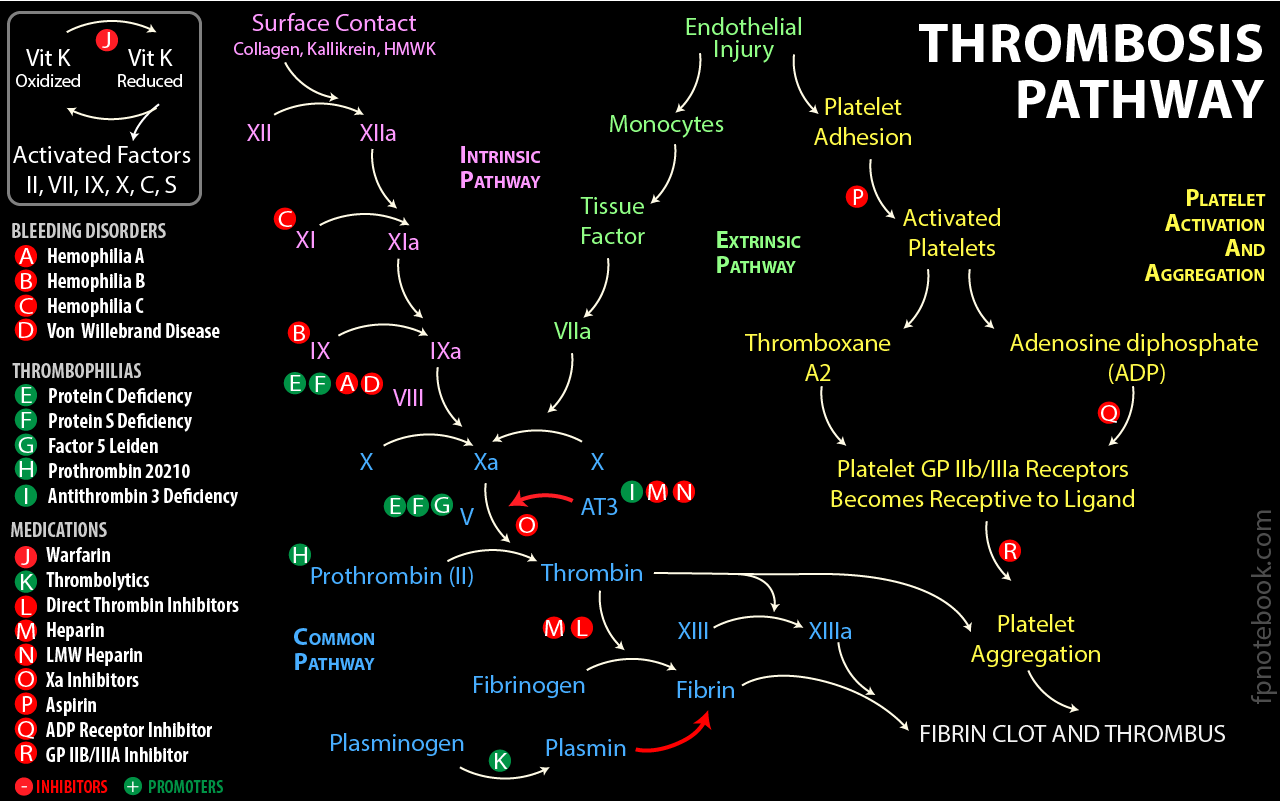
- Full Thrombosis Pathway
-
Warfarin and other Vitamin K Antagonists (VKA)
- Warfarin and VKAs prevent activation of Factors 2, 7, 9 and 10
-
Heparin
-
Heparin binds to, and potentiates Antithrombin III (AT III)
- Antithrombin III binds to and inhibits Serine proteases, Factor IIa (Thrombin) and Factor Xa
- Antithrombin III also binds to and inhibits Factors IXa, XIa and XIIa
- Results in decreased Fibrin formation
-
Unfractionated Heparin
- Composed of Polysaccharides of various lengths, resulting in less predictable Pharmacokinetics, requiring close monitoring
- Heparin also transiently interacts with Thrombin, independent of its action via Antithrombin 3
-
Low Molecular Weight Heparin (LMHW, Enoxaparin)
- LMHW is a small fragment of the larger Heparin molecule (mucopolysaccharide)
- Allows for more predictable Pharmacokinetics, and fewer complications (bleeding, HIT)
-
Heparin binds to, and potentiates Antithrombin III (AT III)
-
Factor Xa Inhibitors (e.g. Rivoroxaban or Xarelto, Apixaban or Eliquis)
- Directly and reversibly bind the active site on Factor Xa
- Block Thrombin formation as a part of the Common Clotting Pathway
- Factor Xa Inhibitors are based on naturally occurring substances
- Antistasin
- Isolated in 1980s from Mexican leach extract
- Tick Anticoagulant Peptide (TAP)
- Isolated from the tick Ornithodoros moubata
- Antistasin
- Directly and reversibly bind the active site on Factor Xa
- Indirect Xa Inhibitors (e.g. Fondaparinux)
- Binds Antithrombin III and modifies its form, substantially increasing its activity by 300 fold
- Super-charged Antithrombin III neutralizes Factor Xa at a markedly increased rate, resulting in Anticoagulation
-
Direct Thrombin Inhibitors (e.g. Dabigatran)
- Selectively and reversibly inhibit free and clot-bound Thrombin
- Prevent conversion of Fibrinogen to Fibrin (which in turn prevents clot)
- ADP Inhibitors (Thienopyridine Class, e.g. Clopidogrel)
- Inhibits Platelet signal transduction
- Inhibits Platelet aggregation
- Reversibly binds Adenosine Diphosphate (ADP) P2Y12-Class Receptors (inhibits G-Protein, Adenyl cyclase)
-
Aspirin
-
Aspirin irreversibly inactivates cyclooxygenase (COX)
- Blocks Thromboxane and Prostaglandin synthesis
- Contrast with NSAIDS which reversibly block COX
-
Platelet Effects (Thromboxane-related)
- Inhibits Platelet aggregation via cyclooxygenase blockade of Thromboxane A2 synthesis
- Aspirin Irreversibly poisons Platelets for their remaining life (8-10 days)
- New Platelets are generated at a rate of 10% per day (25,000/day for a patient with a 250,000 Platelet Count)
-
Aspirin irreversibly inactivates cyclooxygenase (COX)
-
Thrombolytic (Tissue Plasminogen Activator or tPA, TNK-tPA or Tenecteplase)
- Serine protease binds Fibrin and activates Fibrin-bound plasminogen to plasmin
- Plasmin breaks down both Fibrin and Fibrinogen to Fibrin
- Fibrin Degradation Products result, which in turn also act to inhibit Fibrin formation

- Drug Interactions
- Anticoagulants have significant Drug Interactions
- Greatest risk for Drug Interaction is with Warfarin
-
Direct Oral Anticoagulants (e.g. Dabigatran, Rivaroxaban) also have significant Drug Interactions
- Review specific agents for Drug Interactions (e.g. P-Glycoprotein, CYP3A4)
- Highest risk: Ketoconazole, Fluconazole, Ritonavir, Amiodarone
- Unknown safety and bleeding risk when combined with antiplatelet agents
- Reducing DOAC dose due to Drug Interaction risk may render it ineffective
- Review specific agents for Drug Interactions (e.g. P-Glycoprotein, CYP3A4)
- Labs
- Drug Interactions
- Direct Oral Anticoagulants (DOACs) may result in inaccurate results on clot and coagulation based assays
- Tests impacted by DOACs with alternative options
- Lupus Anticoagulant panel
- Consider ELISA Anticardiolipin Antibody and anti-beta2 GP1 Antibody as an alternative
- Activated Protein C resistance
- Consider Factor V Leiden as an alternative
- Lupus Anticoagulant panel
- Tests impacted by DOACs (test when DOAC at trough level before next dose and interpret with caution)
- Protein C Activity
- Protein S Activity
- Antithrombin Activity
- References
- Choosing Wisely (American College of Clinical Pathology)
- Adcock (2015) Thromb Res 136(1):7-12 +PMID:25981138 [PubMed]
- Murer (2016) Lab Med 47(4): 275-78 +PMID:27474775 [PubMed]
- Management
- See Emergent Reversal of Anticoagulation
- Routine follow-up at least every 6 months
- Review compliance and adherence
- Review risk of thrombosis with non-compliance (e.g. Drug-eluting Stent thrombosis, VTE)
- Most Direct Oral Anticoagulants (e.g. Pradaxa, Eliquis) have short half-lives
- Review specific medication guidelines for when to take a forgotten dose
- Review bleeding risk
- Falls or other Trauma
- Gastrointestinal Bleeding, excessive Bruising
- Control Blood Pressure (manage Severe Hypertension aggressively)
- Exercise caution in age 75 years or older, and those who are significantly underweight
- Renal dysfunction (GFR <30 ml/min)
- Obtain Serum Creatinine before starting Anticoagulation
- Previously Warfarin was recommended instead of Direct Oral Anticoagulants if GFR <30 ml/minute
- However, Warfarin associated bleeding risk also increases with decreased GFR
- Avoid Dabigatran (Pradaxa) if GFR <30 ml/min (80% renally excreted)
- Apixiban may be preferred when GFR <30 ml/min (lower overall bleeding risk, 25% renally excreted)
- See Apixiban for Renal Dosing (2.5 mg orally twice daily) indications
- Approved for use in Hemodialysis patients
- Rivaroxaban is also a good choice in Renal Insufficiency (if GFR >15 ml/min)
- See Rivaroxaban for Renal Dosing
- Approved for use in Hemodialysis patients
- References
- Swaminathan and Hayes in Herbert (2019) EM:Rap 19(8):10-11
- Weber (2019) Eur J Haematol 102(4): 312-8 +PMID:30592337 [PubMed]
- Consider Drug Interactions
- See Warfarin Drug Interactions
- Review specific medication P450 interactions
- Avoid NSAIDs
- If Aspirin is being used, confirm appropriate and at low dose (i.e. 81 mg daily)
- DOAC Drug Interactions that decrease Anticoagulation efficacy
- Restarting Anticoagulation after major Hemorrhage (e.g. Hemorrhagic CVA)
- Risk of embolic CVA in Atrial Fibrillation, Prosthetic Heart Valve versus risk of recurrent major bleeding
- Intracranial HemorrhageIncidence 1 in 250 on Anticoagulants yearly (and 15% recurrence rate)
- If Anticoagulation restarted, wait at least 4 weeks after Intracranial Hemorrhage (8-10 weeks if higher risk)
- Indications to restart Anticoagulation
- Prosthetic Heart Valve
- CHADS2-VASc Score 4 or higher (no studies to support a specific score for restarting Anticoagulation)
- Intracranial Hemorrhage predisposing risks have since been mitigated (e.g. Hypertension control)
- Anticoagulant selection and dosing adjustments - special circumstances
- Obesity (weight >120 kg or BMI >40)
- Warfarin (preferred)
- Apixaban (Eliquis)
- Rivaroxaban (Xarelto)
- Avoid Dabigatran (Pradaxa) and Edoxaban (Savaysa)
- Low body weight (<60 kg)
- Apixaban (Eliquis) 5 mg twice daily (2.5 mg twice daily if age >80, or Serum Creatinine >1.5 mg/dl)
- Edoxaban (Savaysa)
- Hemodialysis
- Conditions in which Warfarin is used instead of DOACs
- Mechanical Heart Valve
- Moderate to severe Mitral Stenosis and Atrial Fibrillation
- Higher mortality and stroke risk with Rivaroxaban compared with Warfarin
- Left Ventricular Assist Device (LVAD)
- Antiphospholipid Antibody Syndrome and Thrombosis history
- Breakthough stroke on DOAC
- DOAC Drug Interactions that decrease Anticoagulation efficacy (e.g. Rifampin, Carbamazepine)
- Obesity (weight >120 kg or BMI >40)
- References
- (2015) Presc Lett 22(10): 55-6
- (2017) Presc Lett 24(5): 28
- (2017) Presc Lett 24(7)
- (2022) Presc Lett 29(11): 62
- Prevention
- Bleeding Home Management
- Education
- Educate patients on prevention and control of minor bleeding
- Immediate evaluation for Head Injury, significant injury or bleeding that does not stop after 30 minutes
- Also seek medical care for Hematuria, Gastrointestinal Bleeding or Hemoptysis
- Bleeding may be a sign of excess Anticoagulation (e.g. supratherapeutic INR with Warfarin use)
- Avoid NSAIDS and Herbals that increase bleeding risk (e.g. Garlic, Ginkgo)
-
Epistaxis
- Consider frequent Nasal Saline use to prevent Epistaxis
- If Epistaxis occurs, to pinch the nose in the soft region inferior to the nasal bridge for 10-15 min
- May use intranasal Oxymetazoline or Phenylephrine for up to 3 days if Nasal bleeding recurrs
- Skin Lacerations
- Employ strategies to avoid Skin Trauma (e.g. electric razor instead of razor blade)
- Elevate and apply pressure for 15 min to bleeding sites
- Consider Hemostatic Agents for recurrent bleeding (e.g. styptic pencil, woundSeal)
- References
- (2020) Presc Lett 27(9): 50-1
- References
- Clemens and Oliver (2026) Crit Dec Emerg Med 40(10): 27-37